



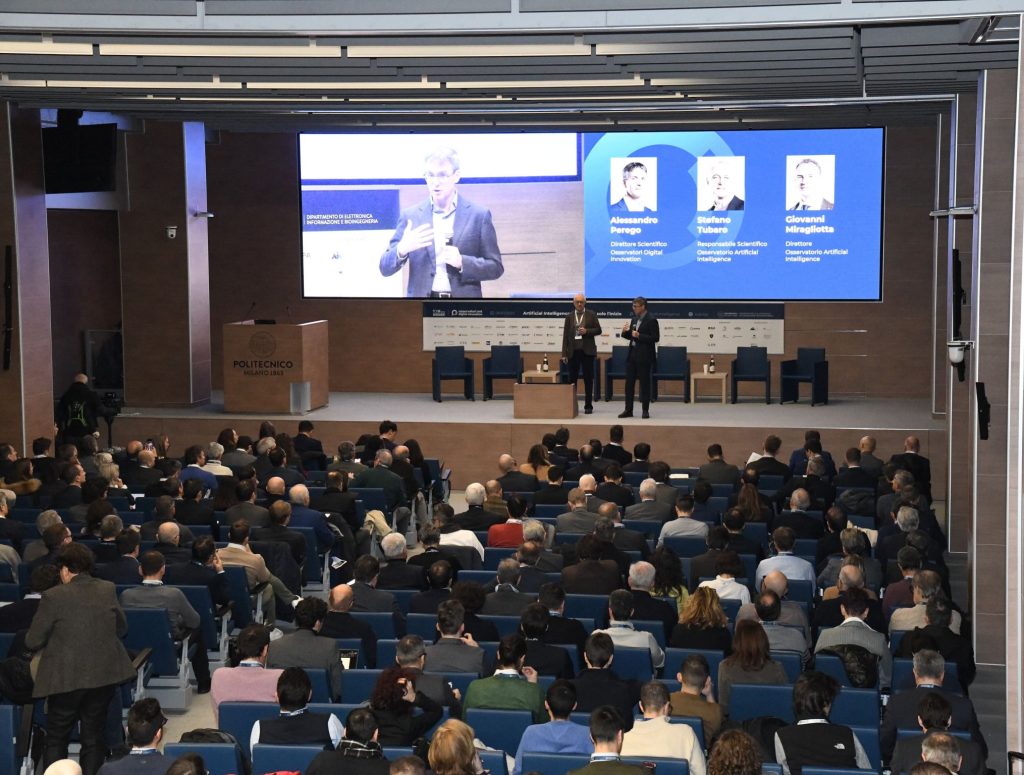
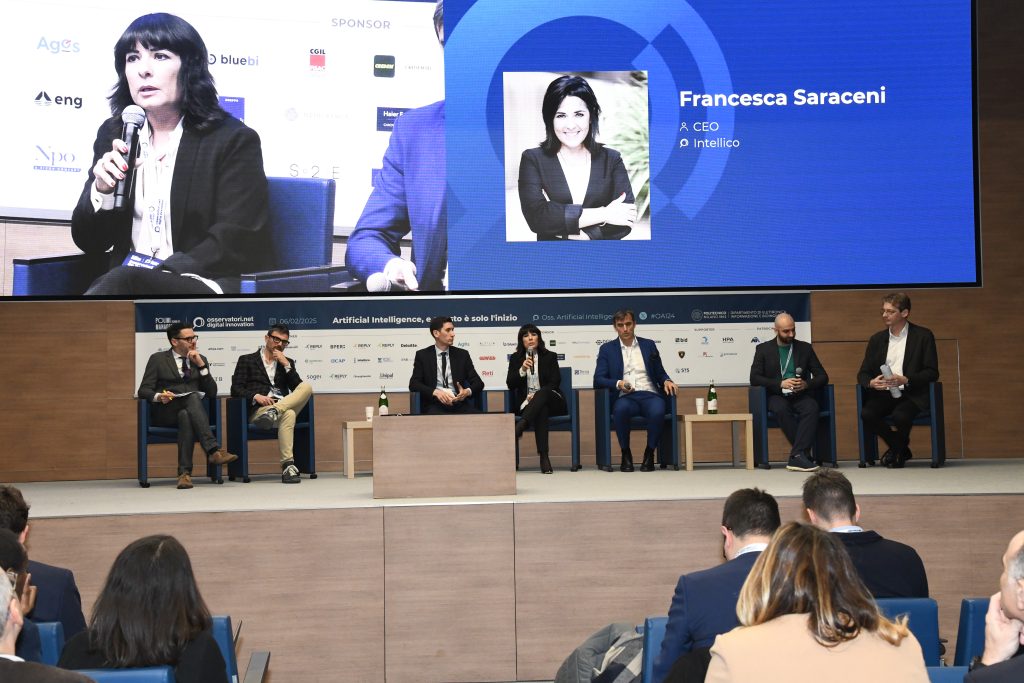
The final conference of the 2024/2025 edition of the Artificial Intelligence Observatory of the Politecnico di Milano, entitled “Artificial Intelligence, and this is just the beginning,” was held on Feb. 6. During the event, they discussed the evolution of the market, the opportunities offered by Artificial Intelligence, and the associated risks to the world of work. A particularly interesting talk introduced the opening of the panel “Beyond LLMs, what technological developments? “, in which we took part as Intellico.
This intervention provided fertile ground for reflecting on key themes that today form the backdrop to the next evolution of AI, allowing us to understand how AI can finally bridge the gap between process digitalization and the digitalization of knowledge and decision-making processes.
The key ingredient lies in the emerging paradigm of Neuro-Symbolic AI, a path that combines the symbolic AI approach with machine/deep learning. This convergence leads us to consider the potential derived from the integration between generative AI and traditional (predictive) AI.
Knowledge Digitalization: The True Breakthrough
Over the last 20 years, the concept of Digital Transformation has often been limited to the digitalization of business processes, introducing ERP, CRM, and, more generally, management systems—both vertical and suite-based—to organize and store information. However, these tools have not truly capitalized on implicit corporate knowledge, meaning the why behind decisions.
True digital transformation does not stop at data storage but extends to knowledge digitalization, the ability to connect explicit and implicit information, transforming it into a strategic asset.
Think about how many times we finalize a quote or offer in a non-predefined context. Typically the order we arrive at is the result of weeks and, in some cases, months of email exchanges, phone calls and draft offers, which is where the real value of our decision-making process lies.
Some interesting attempts were made even before the advent of AI, going in the direction of so-called “collaborative” systems. However, even in the most successful cases, only a small part of “explicit” knowledge was captured and transformed into assets, for example by connecting information present in the exchange of email correspondence to structured information, such as a purchase order that resides in the company management system.
These were timid attempts that did not achieve full interoperability between structured sources (the order) and unstructured sources (the email exchange that led to the order). The need for tracking and historicizing the connection between action and thought, between the decision and the decision flow, was therefore not met. We managed to create very well-organized infrastructures in which to archive information and capitalize on what is typically explicit knowledge, but much of the decision-making process based on implicit knowledge today resides in the operations we carry out on individual productivity tools, communication channels, and unpredictable moments of interaction. All this value, which typically contains the true motivations that led us to a certain decision, is now outside the system.
Today, we are finally moving towards a possible and very concrete future thanks to the combination of predictive AI and generative AI, enabling us to take a significant leap forward in digitalizing the decision-making process.
This means connecting the outcome of our decisions with the flow that led to that choice, replicating this cycle indefinitely, and activating mechanisms of continuous learning and improvement.
Thanks to advanced models, today it is possible to extract, combine and interpret data from structured and unstructured sources, such as documents, emails and conversations, generating useful insights and improving the learning capacity of companies. We are witnessing an epochal transition, where it is finally possible to overcome the limits of traditional management tools. “SaaS is Dead” is in fact one of the most popular claims in recent weeks in the international trade press. But let’s try to understand more.traditional management tools. “SaaS is Dead” is in fact one of the most popular claims in recent weeks in the international trade press. But let’s try to understand more.
Interoperability Between Predictive and Generative AI
One of the main limitations of traditional SaaS software is its rigidity in managing complex and undefined scenarios. However, the integration of predictive AI and generative AI is revolutionizing this approach, enabling automation and optimization of decision-making processes in a more flexible way.
Predictive AI analyzes historical data and identifies patterns while Generative AI simulates scenarios and suggests solutions based on available information.
This combination connects the decision-making flow with the data that generated it, improving adaptability and continuous learning capabilities.
The Future of AI: Towards the Neuro-Symbolic Paradigm
One of the most innovative topics discussed at the conference was the future of AI beyond Large Language Models (LLMs) and the integration between predictive and generative AI: Neuro-Symbolic AI.
This paradigm combines two distinct approaches:
- Symbolic AI (GOFAI – Good Old-Fashioned Artificial Intelligence), based on predefined rules and logic for managing explicit knowledge.
- Machine Learning and Deep Learning, which generalize information and learn from large amounts of data.
Neuro-Symbolic AI overcomes the limitations of both, creating hybrid systems capable of managing both explicit and implicit knowledge. This model opens new possibilities for intelligent automation, making AI systems more transparent, interpretable, and efficient.
At Intellico.ai, we are already exploring concrete applications of this paradigm in both the retail and manufacturing sectors, aiming to create AI solutions that support complex and high-value decision-making processes.
For example, Neuro-Symbolic AI can extract key parameters from briefs or web content analyses to configure a marketing campaign. Similarly, it can extract constraints from manuals to set and regulate the correct operational parameters of a production process.
The evolution of AI towards these paradigms represents a decisive leap forward, enriching and enhancing our ability to deliver solutions focused on empowering decision-making processes. More importantly, it enables businesses to capitalize on implicit knowledge as a corporate asset, an invaluable resource derived from individual experience and expertise.
Intellico.ai’s Role in AI Evolution
How do we envision the future of AI?
We believe that AI solutions will not completely replace traditional enterprise systems that have been consolidated over time. The claim “SaaS is Dead” is not a scenario we consider feasible. Instead, we foresee a hybrid approach, where traditional transactional solutions and AI-based systems will coexist and complement each other. Just as mobile technology did not eliminate personal computers, nor did cloud computing fully replace on-premise solutions, SaaS will also evolve into a hybrid model, where legacy, client-server, and advanced AI solutions will operate synergistically.
At Intellico.ai, we strongly believe that true innovation lies in the fusion of computing power and interpretability to support more transparent, effective, and intelligent decision-making processes, transforming the way strategic decisions are made.
Contributors:
Francesca Saraceni, Ceo Intellico
Sara Uboldi, Head of Solutions Intellico