


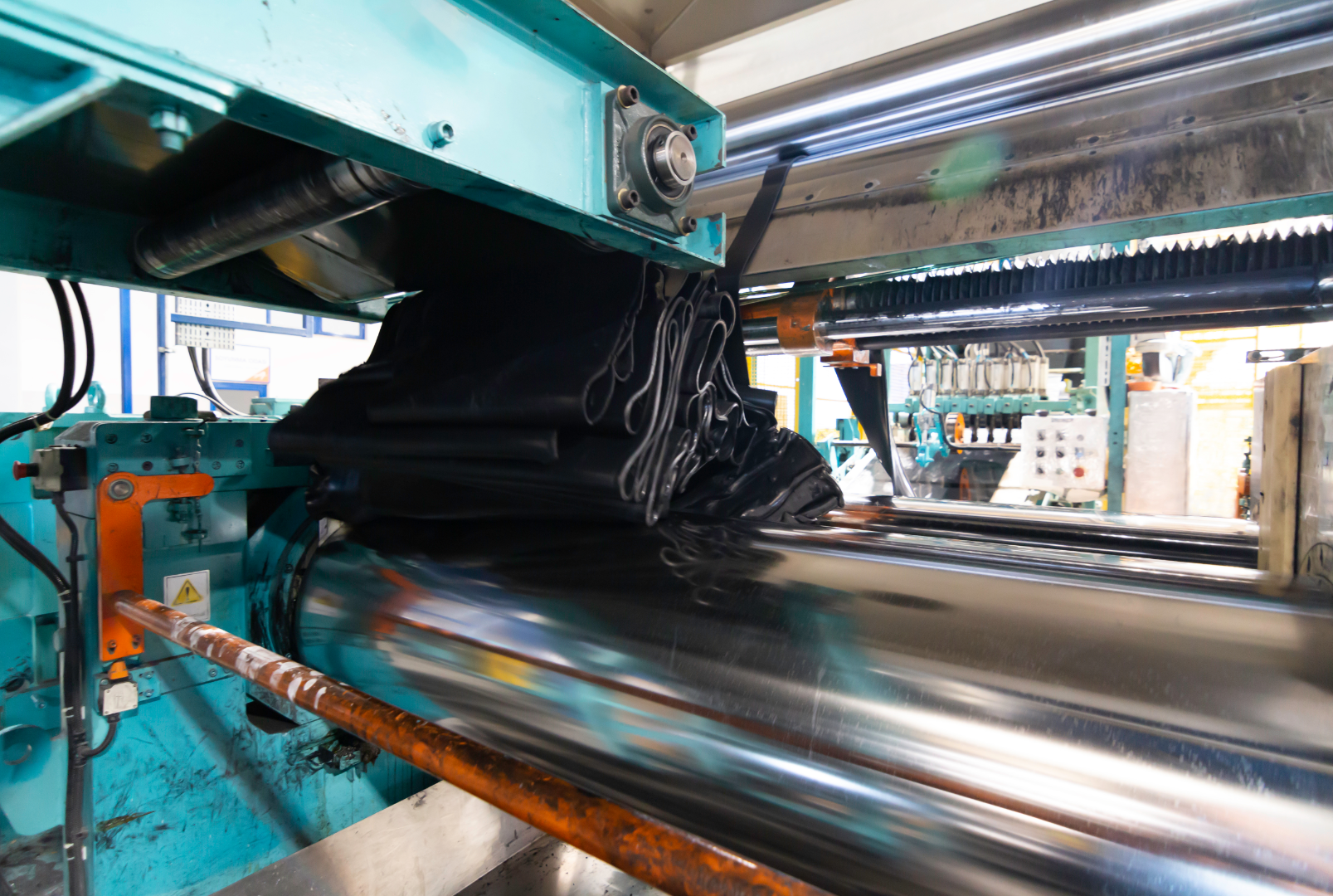
After exploring the applications in the cosmetics and food industries, today we share a concrete use case in the formulation of rubber compounds — a sector where the R&D department plays a key role in defining the optimal combination of ingredients and processes to achieve the desired performance.
Every new formulation requires testing, experimentation, and iterative refinements, generating a significant amount of experimental data. However, this information often remains scattered across Excel files, paper notes, and management software, making day-to-day work challenging and hindering the structured use of this data for future optimization or to enable predictive tools powered by artificial intelligence.
The Client’s Need
The client is a medium-sized Italian company with over 80 employees and an annual turnover of more than €50 million. It has been producing rubber compounds for industrial applications for over fifty years. Operating in a technical and highly specialized market, the company provides customized compounds for sectors such as automotive, construction, pharmaceuticals, and other industrial applications.
With a production capacity of over 100,000 tons per year and a dedicated R&D team, the company manages a portfolio of thousands of formulations and invests in innovation to stay competitive on an international scale.
The main challenge was transforming formulation data — fragmented, unstructured, and difficult to access — into centralized, valuable information. This would later enable predictive models capable of significantly reducing time to market and increasing competitiveness.
Within the company, the R&D department includes around ten people, organized into specialized teams based on the rubber’s end-use. Despite having generally shared and defined workflows, three key operational challenges remained:
- Tool heterogeneity: data was collected across multiple platforms — Excel spreadsheets, Word documents, management software, and handwritten notes — some of which were poorly suited for structured technical information management;
- Incomplete data recording: not all relevant or contextual test data was consistently logged, making it difficult to reconstruct the full development path;
- Content variability: inconsistent nomenclature, different units of measurement, and varied data entry formats across users and departments.
These factors made structured management of formulation data difficult and greatly limited the potential to leverage historical data for analytical and predictive purposes.
The client wasn’t just looking to digitize the current state but wanted a practical solution to support formulators in their daily data collection, ensuring consistency, completeness, and quality at the source. This would gradually build a reliable database capable of powering AI and predictive simulation tools in the future.
In a growing sector, every week gained in developing a new compound becomes a competitive advantage. In Europe alone, the industrial rubber market exceeds $25 billion and continues to expand, with a projected annual growth rate of +5.8% until 20311, increasing pressure on lead times, operational agility, and time-to-market.
Recent studies, such as one published in Polymers (MDPI)2, show that neural networks can predict with over 93% accuracy the mechanical properties of compounds — including hardness, modulus, and elongation — from formulation data. This approach enables optimized design, reduced reliance on physical testing, and early insight into recipe effectiveness during the simulation phase, yielding tangible benefits in speed, efficiency, and development reliability.
In short, digitizing and structuring formulation data isn’t just about organization — it’s the prerequisite for competing in a fast-moving market where advantage is measured in days, not months.
Implemented Solution
To meet these needs, the client chose Matilde as their go-to platform. Matilde not only offers AI-based simulation and prediction features but is specifically designed to support the daily work of collecting, organizing, and managing experimental formulation data — starting from the earliest operational stages, ensuring data is gathered with an AI-driven mindset from the outset.
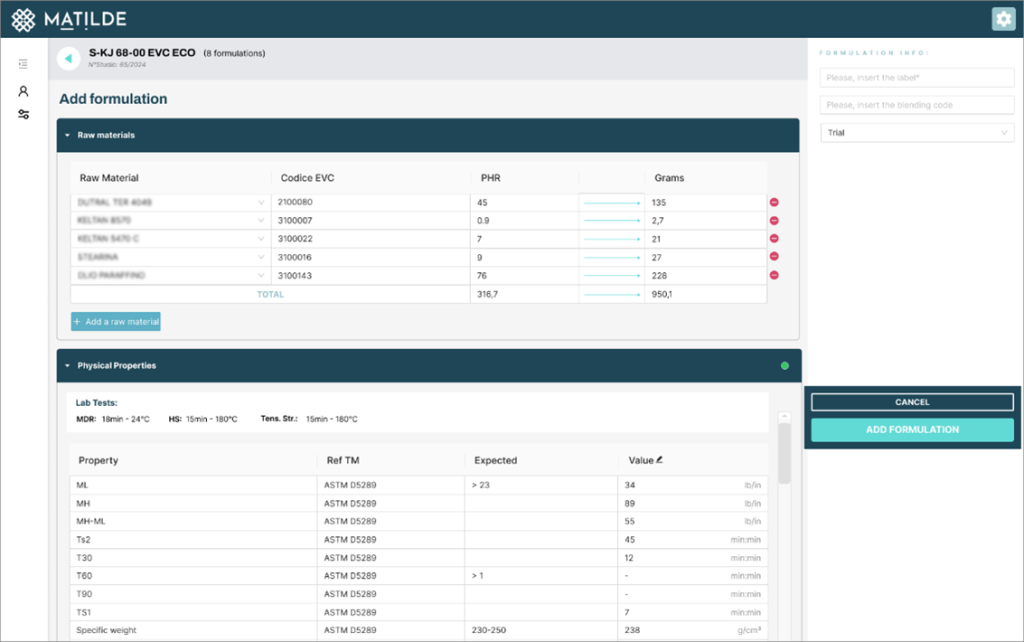
Data registration in Matilde enables detailed and consistent data collection, immediately building a strong knowledge base ready for predictive modelling. Having accurate, complete data is essential for any successful AI application.
To further tailor Matilde to the lab’s specific operations, the platform was enhanced with:
- the option to configure the tests to be performed at the project level, ensuring consistency and completeness in testing activities.
- the ability to register formulations either in percentages or in parts of rubber, depending on the formulator’s preferred method;
- a function to rapidly generate new formulations based on existing compounds, saving time and reducing the risk of errors;
Expected Benefits and Future Developments
The digitalization of data collection using Matilde has already delivered tangible improvements: faster daily operations, more precise traceability of information, and fewer errors in managing formulations. The value of these results becomes even more evident in the medium-to-long term, thanks to the ability to gradually build a solid, well-structured database.
With a structured dataset now in place, the company is ready to take the next step: activating Matilde’s predictive simulation module, which enables:
- a reduction in the number of physical tests required, cutting down both time and costs;
- the ability to simulate new formulations in a virtual environment, optimizing composition before experimental trials;
- discovery of correlations between ingredients, processes, and performance through interpretable AI models.
It’s essential to underline that these developments are only possible if data is collected completely, consistently, and in a standardized manner. This is the foundational step for any successful AI project: preparing for advanced predictive tools requires a reliable data infrastructure that captures the full informational value a company holds.
For companies facing similar challenges in formulation management, it may be useful to explore gradual digitalization paths focused from the outset on data quality and consistency.
Discover how Matilde can help you rethink and enhance your product development activities, reducing time to market by up to 60%: 🔗 https://intellico.matilde.ai/
References:
1Rubber World, Global industrial rubber market forecast, 2024: https://rubberworld.com/global-industrial-rubber-market-forecast-at-37-5-billion-by-2031/
2Román, A.J.; Qin, S.; Rodríguez, J.C.; González, L.D.; Zavala, V.M.; Osswald, T.A. Natural Rubber Blend Optimization via Data-Driven Modeling: The Implementation for Reverse Engineering. Polymers 2022, 14, 2262. https://doi.org/10.3390/polym14112262