

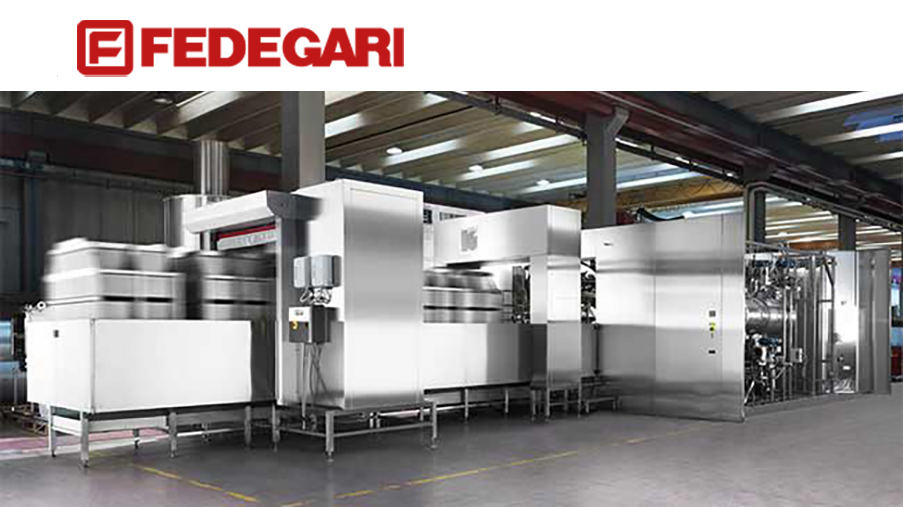
The customer’s need
Think about what it takes to build a sterilization system for a pharmaceutical plant. Not the engineering itself, but what comes before: the moment a potential customer sends over a document outlining exactly what they need. In the world of pharmaceutical equipment manufacturing, these documents – User Requirement Specifications, or URS – can run to hundreds of pages and contain as many individual technical and regulatory requirements. Every requirement must be evaluated, every deviation from the standard offering must be justified, and every response must be technically precise and regulatorily defensible.
The clock, meanwhile, is ticking.
For companies like Fedegari Autoclavi SpA – a global leader in the design and manufacture of sterilization systems for the pharmaceutical sector — this is the reality of every competitive tender. Operating in an Engineer-to-Order model means that each project is, by definition, unique: tailored to the customer’s product, their plant, their regulatory context, and their validation strategy. There is no
standard answer. There is only the ability to find the right answer faster than the competition. That task has grown considerably more demanding in recent years.
For instance, revision of the principal European standard for sterile manufacturing environments — introduced significant new requirements around contamination control strategy, cleanroom classification, and equipment design. A team capable of navigating this landscape with confidence is a competitive asset; a team navigating it manually, document by document, is a bottleneck.
The Solution Implemented
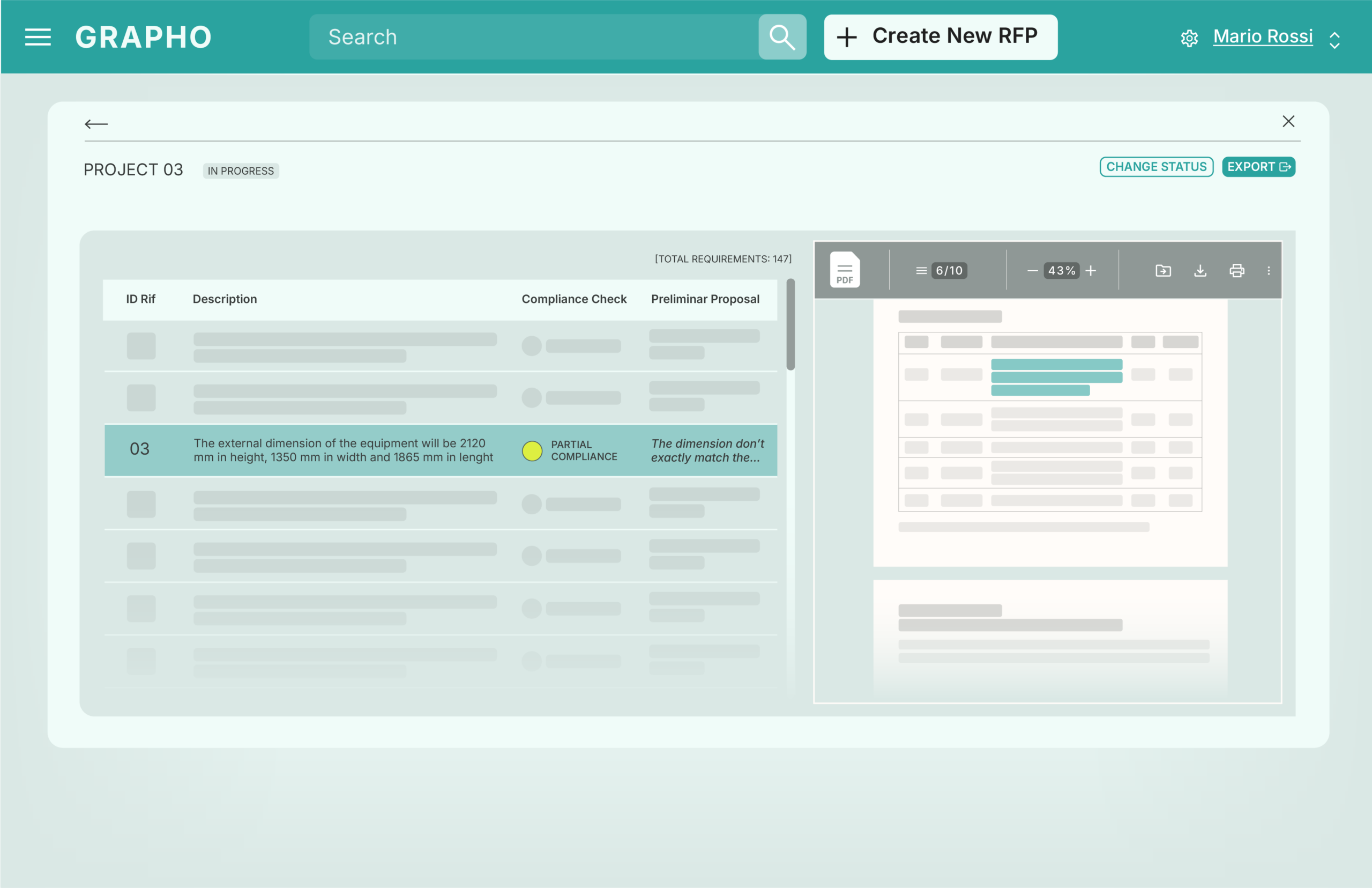
This is why Fedegari partnered with Intellico.ai to implement GRAPHO, an AI-powered solution specifically designed to streamline tender management in highly regulated machine-building industries. Where a standard search engine retrieves documents, GRAPHO reads requirements. It automatically extracts every technical and regulatory requirement from an incoming URS – whether expressed in free-text narrative or structured table format – and evaluates each one against Fedegari’s managed product offering and the body of technical decisions accumulated over years of prior projects.
Requirements fully covered by the standard offering are confirmed as such. Those that are partially covered or pose a genuine compliance or technical risk are surfaced for expert review. When similar requirements have been addressed in past tenders, the system identifies the most relevant precedents and proposes draft responses grounded in the company’s existing technical and compliance documentation – including product manuals and historical compliance matrices. The analyst receives not a stack of documents to search, but a structured starting point for a decision.
The impact on how the team works has been immediate. Documents that previously required days of analyst time can now be processed in minutes. This does not replace the judgment of experienced engineers and commercial managers – it changes what they spend that judgment on. Instead of manually scanning specifications and cross-referencing internal libraries, the team can focus on the requirements that genuinely demand human expertise: the edge cases, the novel compliance challenges, the strategic calls about how to position the offer.
The result
Overall manual processing time has been reduced by 60–70% for structured document tasks and is expected to decrease by up to 90%.
For a commercial team, that difference is not incremental – it is structural. It means the team can engage with more tenders in the same time, respond to urgent requests without pulling resources from active
projects, and bring greater analytical depth to the bids that matter most.
Fedegari’s challenge is far from unique.
Across “Engineering to Order” and “Make To Order” manufacturing – from process equipment to packaging automation – companies compete for contracts where the customer’s requirements arrive as a detailed specification document. Wherever that document must be read, interpreted, and
responded to with precision under time pressure, the process of doing so represents a bottleneck with both commercial and strategic consequences. As regulatory frameworks continue to evolve and customers raise their expectations around response quality, the companies that invest in turning institutional knowledge into a systematic competitive advantage will find themselves in a structurally different position – one where speed and precision are no longer a trade-off.
“GRAPHO allowed us to focus our resources on strategic decisions, enabling us to respond quickly and effectively to our clients’ needs.”
Gianluca Rossi, Sales and Marketing Director – Fedegari Autoclavi SpA
In conclusion
One of the broader lessons from projects like this is that AI can finally make practical what decades of enterprise software attempted but never fully delivered: supporting complex, document-intensive decision-making at scale without losing traceability or organizational control over the reasoning behind each decision. Traditional systems were built for structured transactions. They handled predefined workflows well but struggled whenever decisions required reading large volumes of unstructured documents, connecting fragmented institutional knowledge, or applying contextual judgment.
Those tasks remained dependent on individual expertise because the reasoning behind them could not be systematically captured or reused.
What changes with purpose-built AI is not only speed — it is architecture. In regulated industrial environments, value depends not just on generating answers, but on ensuring that every step of the process — from requirement extraction to technical correlation to final decision — is controlled, auditable, and consistent. As companies move from AI experimentation into operational deployment, this combination of analytical capability and disciplined information governance is becoming less a design preference and more a baseline requirement.