

Waste, not resource
Every year, industry generates enormous volumes of waste that could become something valuable instead of ending up in a landfill: ash from waste-to-energy plants, slag from steelmaking, and other industrial residues like ashes that today are simply buried at a cost — both financial and environmental. At the same time, the pressure to capture and store carbon dioxide, rather than release it into the atmosphere, is reshaping how industries think about their own waste. Turning yesterday’s byproduct into tomorrow’s raw material, while locking away CO2 in the process, is one of the most concrete ways heavy industry can become part of the climate solution rather than the problem.
Making that shift, however, is harder than it sounds. Every batch of industrial waste is slightly different — its composition changes with the plant, the season, and the process that produced it. Before a new recycled material can replace a traditional one, it has to prove it performs just as well, batch after batch. That normally means months of physical testing in the lab for every new recipe, at a stage in a company’s growth where historical data is still scarce and every experiment counts.
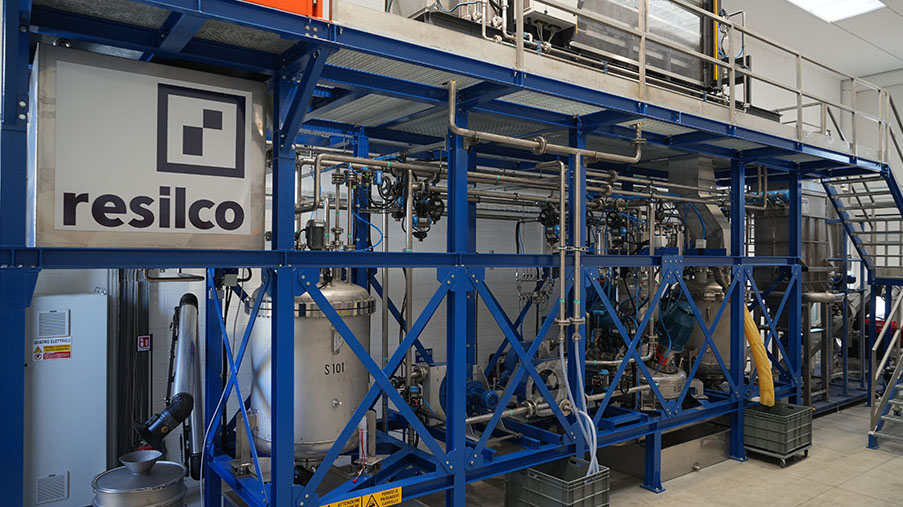
One of the companies tackling this challenge is Resilco, an Italian Società Benefit based between Monza and Milan that has developed a patented technology to recover industrial waste — such as fly ash and steel slag — and turn it into secondary raw materials, while permanently capturing carbon dioxide inside them in the process. Supplementary Cementitious Materials (SCMs) have indeed the possibility to partially replace virgin material in construction products, but their validation passes across several tests, physical, chemical, performance and environmental.
Predicting before testing
To accelerate the validation of new material formulations, Resilco partnered with Intellico. Leveraging its expertise in AI-driven prediction of chemical and physical material properties through its MATILDE platform, Intellico was able to provide a solid foundation for the project. The solution was then tailored to Resilco’s specific needs by training predictive models on the unique characteristics of construction materials and extending the prediction framework to include key process parameters. This enabled the estimation of material performance and quality indicators before laboratory testing, significantly reducing experimentation time and supporting faster decision-making.
Rather than waiting weeks for a physical sample to cure and be tested, Resilco’s team can now describe a new material recipe to the tool: the physical and chemical characteristics of the waste, the expected treatment and the planned process parameters. The team receive an early estimate of how strong it will be once it hardens — a prediction based on the composition of the mix and how similar materials have performed in the past.
Moreover, the tool does not just return a number. Thanks to its Explainable AI dashboards, it explains which ingredients and characteristics are driving its estimate, so the scientists reviewing it can judge for themselves whether the reasoning makes sense, rather than trusting a black box. Every prediction is treated as a starting hypothesis to guide the next physical test, not a replacement for it.
Twenty recipes
~20
real recipes in the dataset
1 · 4
weeks of curing predicted
1st
version already operational
The first version of the tool was built and tested on a small set of about twenty real recipes — a fraction of what most predictive models would need to be considered reliable. Even so, it was able to estimate how strong the recycled material would be after one and four weeks of curing, with an accuracy in line with published results from studies that relied on far larger datasets.
For a company still building up its own body of experimental data, that is a meaningful result: it shows the same approach can be trusted even before decades of records have been accumulated, giving Resilco a solid foundation to build on as it expands to new materials and processes.
“We are pleased to collaborate with Intellico to integrate AI into the management of incoming waste flows. Thanks to this new advanced tool, Resilco can optimize every stage of the operational process, ensuring excellence and cutting edge solutions in the circular economy sector.”
— Davide Callejo Munoz
CEO Resilco S.r.l. Società Benefit
From pilot to scale
Based on results achieved, the next phase focuses on the industrialization of the predictive models and the full-scale deployment of the platform. Particular attention will be given to defining the most effective methods for real-time data collection, tracking, and governance, with the objective of building a scalable data architecture aligned with Resilco’s growth strategy. Strengthening the quality, consistency, and availability of process and material data will further enhance model performance while creating the foundations for a data-driven approach to product development and operational optimization.
Beyond construction materials
The challenge facing Resilco is not unique to recycled construction materials. Across the wider circular economy — from recovered plastics to reclaimed metals to bio-based materials — companies face the same fundamental tension: waste streams are variable, historical data is limited, processes are not stable and every physical test costs time and money that a growing company can rarely spare. As pressure builds to replace virgin raw materials with recycled ones, and to capture rather than emit carbon dioxide, the ability to get a trustworthy early read on a new material’s performance — without waiting on months of lab work — will increasingly separate the companies that scale their sustainability efforts from those that stay stuck at pilot scale.